

Multiligament injury of the knee
A multi-ligament injury of the knee occurs when several ligaments are damaged simultaneously. It often happens following significant trauma and can compromise the stability of the joint.
Treatment depends on the ligaments affected, the severity of the injury, and the possible presence of associated conditions. A prompt examination is essential to check blood circulation and sensation in the leg.
UNDERSTANDING MULTILIGAMENTOUS KNEE INJURY

RECOGNIZING THE SYMPTOMS
A multi-ligament injury of the knee usually occurs after a significant trauma: sports injury, fall, traffic accident, or forced movement of the joint. The signs can vary depending on which ligaments are affected and any associated injuries.
- Severe pain: It appears at the time of the trauma or shortly afterwards. It can affect several areas of the knee.
- Rapid swelling: A blood effusion in the joint can cause the knee to swell in a short time.
- Instability: The knee may feel like it is giving way or no longer holding properly.
- Difficulty gaining support: Pain and instability can make walking difficult, or even impossible.
- Temporary deformation: A dislocated knee can reduce spontaneously before examination. Therefore, the absence of visible deformity is not sufficient to rule out a serious condition.
- Tingling or numbness: These sensations in the leg or foot may indicate nerve damage.
- Cold, pale or bluish feet: These signs, or a decrease in sensation, may indicate a circulatory problem and require urgent attention.
Pain and swelling may decrease without restoring knee stability. A persistent feeling of instability, an abnormal gait, or apprehension when changing direction warrants a specialist evaluation.
HOW DOES A MULTILIGAMENTOUS KNEE INJURY OCCURS?
A multi-ligament injury occurs when a significant force exceeds the ligaments' stabilizing capacity. The injury may involve two or more ligaments, sometimes with a knee dislocation, fracture, or damage to surrounding structures.
High-energy trauma
A traffic accident, a serious fall, or a direct trauma can cause a sudden displacement of the joint surfaces. Even if the knee spontaneously returns to its original position, several ligaments may have been stretched or torn.
Torsional or stress movement
In a sports injury, the foot may remain fixed to the ground while the body rotates, or the knee may be subjected to a lateral force or hyperextension. Depending on the direction of the stress, different ligaments may be affected simultaneously.
Knee dislocation
A dislocation is a significant displacement of the joint surfaces. It may reduce itself before arrival at the hospital, but the initial trauma may have stretched or damaged nearby blood vessels and nerves. Therefore, urgent evaluation is necessary even if the alignment appears to have returned to normal.
Frequently associated lesions
A multi-ligament injury may be accompanied by meniscal damage, a tibial plateau or femoral fracture, cartilage damage, or injury to the popliteal artery or fibular nerve. These factors influence treatment priorities.

MAKE THE RIGHT DIAGNOSIS
The diagnosis combines the circumstances of the trauma, a careful clinical examination, and imaging studies. In cases of multi-ligament injury, the assessment also looks for circulatory or nerve damage.
01 — THE CIRCUMSTANCES OF THE TRAUMA
The doctor specifies the direction of the force, the position of the knee, the presence of any deformity, and whether or not weight-bearing is possible. He also gathers information on sensations in the leg and foot since the accident.
02 — THE CLINICAL AND NEUROVASCULAR EXAMINATION
After assessing the overall condition of the knee, the doctor examines sensation, foot movement, and circulation in the leg. Ligament stability is carefully tested and adjusted according to the level of pain. Some tests may be repeated as the swelling subsides.
03 — X-RAYS
X-rays are used to look for a fracture, joint displacement, or a bone fragment avulsed from the ligament insertion. Depending on the situation, additional X-rays or vascular examinations may be requested quickly.
04 — MRI AND ADDITIONAL EXAMINATIONS
MRI helps to pinpoint which ligaments are affected and to identify any associated damage to the menisci, cartilage, or soft tissues. If blood flow is involved, urgent vascular investigation may be necessary; MRI does not replace this assessment.
A normal appearance of the knee after the accident does not rule out a transient dislocation or vascular damage.
PROTECT THE KNEE AND ASSESS INJURIES WITHOUT DELAY
After a significant injury, the priority is to protect the leg and check blood circulation and nerve function. Definitive treatment is decided once the immediate situation has been assessed and the injuries more fully characterized.
Immediate measures
Avoid putting stress on or manipulating the knee. Keep it in a comfortable position, without trying to correct any deformity. If you can do so without pain or risk of falling, slightly elevate the leg. A cold pack wrapped in a cloth can help reduce pain and swelling, without being applied directly to the skin.
Protection and displacement
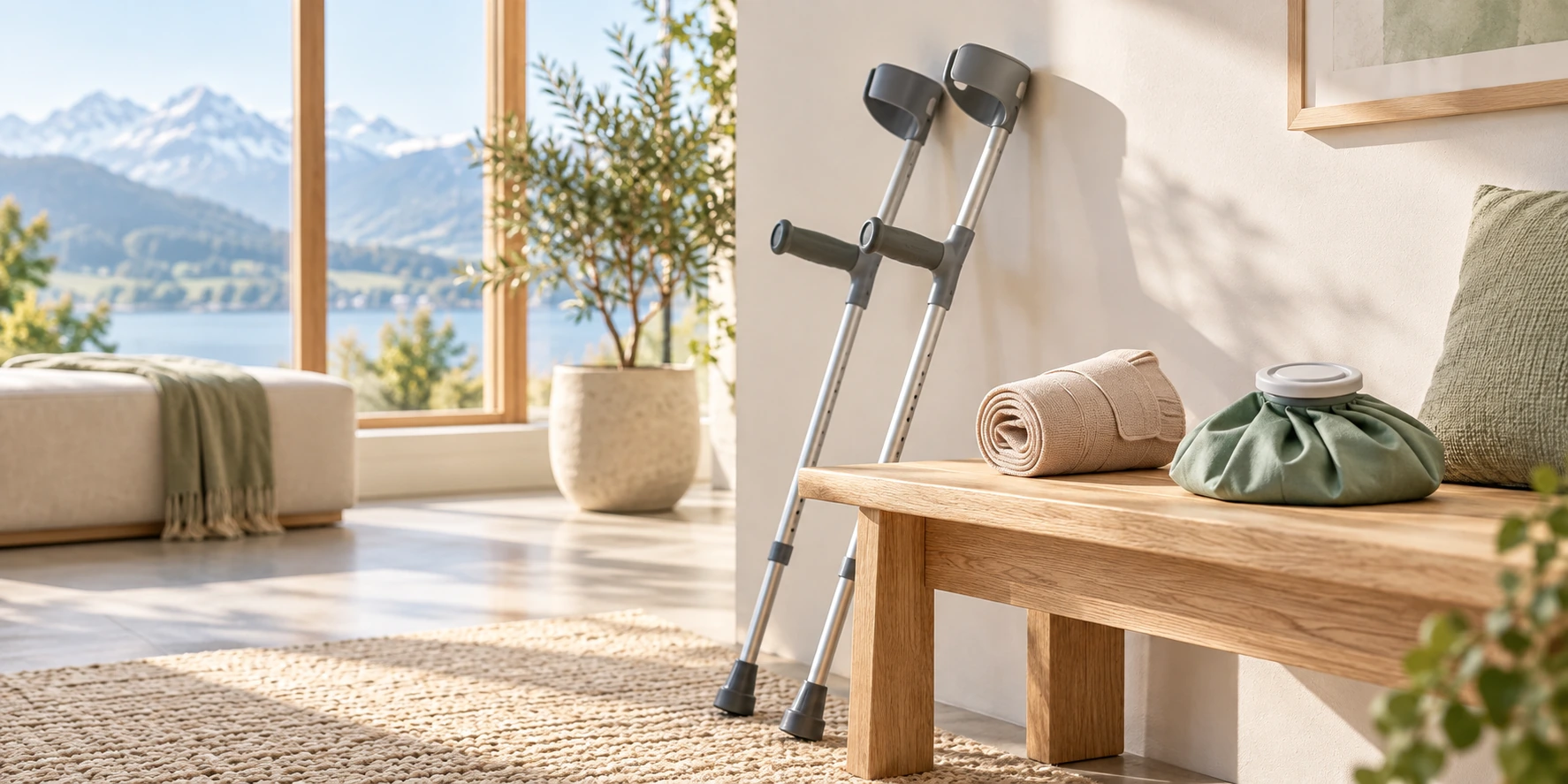
A brace can be applied by professionals to protect the knee. Crutches may be recommended if weight-bearing is painful or inadvisable. The choice of support and immobilization depends on the injury and the state of circulation.
Symptom relief
Pain medications are chosen based on medical history and contraindications. Do not take any additional medication without medical advice if you have chronic illnesses, are taking anticoagulants, or have already received specific instructions.
Quick assessment
Suspected dislocation, a cold or pale foot, tingling, or loss of sensation require immediate evaluation in the emergency room. To arrange a specialist evaluation in Geneva, consult SOS Knee Geneva — specialized consultation and imaging.
Preserving the natural joint remains a priority as long as conservative treatments allow for maintaining a satisfactory quality of life.
CAN A MULTILIGAMENTOUS INJURY BE TREATED WITHOUT SURGERY?
Surgery is not always necessary. Conservative treatment may be considered if the assessment shows sufficient stability, if some lesions are partial or isolated, and if the patient's functional goals can be achieved without reconstruction. The decision also depends on any associated injuries and the absence of vascular or nerve problems requiring urgent intervention.
Progressive physiotherapy
Physiotherapy aims first to reduce pain and swelling, then to gradually restore mobility, strength, and control of the knee. Exercises and their progression are tailored to the affected ligaments. Weight-bearing or certain movements may be temporarily limited according to medical advice.
Adaptation of activities
Activities involving pivoting, rapid changes of direction, jumping, or a risk of falling are suspended during the assessment and protective phase. Resumption of daily activities is gradual, depending on the stability and response of the knee.
Protection and monitoring
A hinged splint or crutches may be helpful for a period determined by the specialist. Follow-up appointments allow for reassessment of stability, mobility, and the progress of physiotherapy.
When to reassess the strategy?
Persistent instability, episodes of loss of balance, significant activity limitations, or a lack of functional improvement warrant a reassessment of the diagnosis and treatment options. The decision takes into account the patient's symptoms, examinations, and goals.
Conservative treatment is chosen after a precise assessment and is accompanied by follow-up adapted to the ligaments concerned.
To better understand a common associated condition, see the page chronic knee instability.
KNEE LIGAMENT RECONSTRUCTION AND REPAIR
Surgery may be considered when several ligaments are torn and the knee remains unstable, when the expected function requires stability that conservative treatment cannot achieve, or when certain associated injuries require a specific procedure. Surgery is not decided solely on the basis of an MRI image.
The principle of intervention
The surgeon assesses the affected ligaments, their condition, location, and any associated damage. Depending on the case, they may repair a ligament when its configuration allows, or reconstruct its function using a tendon graft. One or more structures may be treated during a single procedure, or according to a multi-stage strategy.
Techniques adapted to the affected structures
ACL and PCL reconstructions often rely on a tendon graft fixed to the bone. Certain injuries to the collateral ligaments or posterolateral structures can be repaired or reconstructed depending on their location and age. Fractures, meniscal tears, and vascular lesions require a specific strategy and may alter the order of treatment.
Choosing the right time
Urgent repair of a vascular injury or displaced fracture may take priority. For ligaments, the timing of intervention depends on factors such as the condition of the skin and tissues, swelling, restored mobility, and the nature of the injury. Some situations warrant early surgery; others benefit from delayed or staged intervention. There is no single timeline that applies to everyone.
Preserve the fabrics whenever possible
When the anatomy and tissue quality allow, their repair or preservation can be discussed. The choice takes into account the chances of healing, the expected stability, and the constraints of rehabilitation.
The surgical strategy aims to treat the identified lesions while taking into account the entire knee and the recovery process.
To learn more about ligament reconstruction, consult the article on anterior cruciate ligament surgery. It focuses on the ACL and does not, by itself, describe all multi-ligament situations.
REHABILITATION AND RESUMPTION OF ACTIVITIES
Rehabilitation is progressive and depends on the number of ligaments affected, any associated injuries, and the treatment received. Restrictions on weight-bearing, range of motion, or movement are determined by the healthcare team.
PROTECT AND CONTROL INFLATION
The first phase adheres to the guidelines for support and splinting. The work focuses in particular on controlling pain and swelling, as well as on muscle activation without excessive stress on the repaired or reconstructed structures.
REGAIN MOBILITY
Flexion and extension are regained according to a program adapted to the ligaments involved. Range of motion is increased gradually, without forcing movements that put stress on the healing structures.
RESTORE STRENGTH
Strengthening of the thigh and hip muscles resumes gradually. Progress depends on the quality of knee control, pain levels, and adherence to postoperative instructions.
WORK ON MOVEMENT CONTROL
Balance, coordination, and knee control during functional movements are developed before more demanding tasks. Walking, changes of direction, and professional gestures are reintroduced based on observed progress.
RESUME ACTIVITIES AND SPORT
Returning to sport depends on stability, mobility, strength, movement control, and functional tests tailored to the intended activity. For multi-ligament injuries, recovery can take many months.
The resumption decision is based on functional criteria and regular monitoring, not on a single date.
→ Discover the stages of rehabilitation after knee ligament surgery.

A CARE APPROACH TAILORED TO EACH PATIENT
There is no single treatment for all multi-ligament knee injuries. Dr. Benoît Coulin considers the ligaments involved, the extent of the damage, joint stability, any associated injuries, and the progression of symptoms. He also takes into account the patient's age, daily and professional activities, athletic level, and goals.
Conservative treatment avoids surgery and may be suitable for certain injuries, but it requires ongoing physiotherapy and reassessment if instability persists. Surgery can restore stability when indicated, but it involves an intervention and a lengthy rehabilitation period. The timing and techniques are chosen based on the structures involved and the condition of the knee.
The discussion helps to clarify the expected benefits, limitations and constraints of each option before deciding on the next steps.
«"The priority is to secure the knee, then to choose a strategy adapted to the injuries and the patient's objectives."»
FREQUENTLY ASKED QUESTIONS
Has your knee suffered a significant injury?
A clinical examination and appropriate imaging allow identification of the affected ligaments, verification of neighboring structures and definition of the next steps in management.
After a significant injury, deformity, or signs affecting circulation or sensation in the foot, contact the emergency room. For a specialized evaluation in Geneva, visit [website address]. SOS Knee Geneva.
