

PARTIAL KNEE REPLACEMENT
A partial knee replacement, also called a unicompartmental knee replacement, replaces the worn joint surface in only one area of the knee. It preserves the remaining healthy compartments and much of the natural anatomy.
This intervention may be considered when pain and discomfort persist despite appropriate management. The decision is based on symptoms, clinical examination, imaging studies, the status of other body compartments, and the patient's goals.
UNDERSTANDING PARTIAL KNEE REPLACEMENT

-
This is the area located on the inner side of the knee and is the most frequently affected by osteoarthritis. Its wear and tear can cause internal pain and gradually lead to leg deformity.
-
Located on the outer side of the knee, this compartment is less frequently affected. Its wear and tear can cause lateral pain and gradually alter the leg's alignment.
-
This joint is located between the kneecap and the femur. When it is affected, pain often appears when climbing stairs, squatting, or after sitting for a long time.

WHO IS PARTIAL KNEE REPLACEMENT SUITABLE FOR?
A partial knee replacement can be considered when wear is limited to one compartment and the other structures of the knee remain sufficiently functional. It is not suitable for all forms of osteoarthritis: ligament stability, mobility, and alignment must also be assessed.
1- Wear limited to one compartment
Osteoarthritis should primarily affect one area of the knee. If several compartments are affected, another solution may be more suitable.
2- Persistent pain and discomfort
The discomfort must affect daily activities despite appropriate non-surgical management, such as physiotherapy and activity adaptation.
3- Ligaments and other surfaces sufficiently preserved
The functioning of the ligaments, particularly the anterior cruciate ligament, and the condition of the cartilage in the other compartments are taken into account in the assessment.
4- Compatible mobility and alignment
Knee mobility and leg alignment should allow for consideration of this option. The surgeon also assesses any associated injuries and the patient's functional needs.
A partial denture is not automatically indicated as soon as an X-ray shows localized wear. If symptoms remain mild, if other treatments are still appropriate, or if multiple compartments are affected, surgery may be postponed or another strategy proposed.
→ Understanding the symptoms and treatments of knee osteoarthritis
PREPARE FOR THE INTERVENTION
Preparation allows us to verify that the intervention is appropriate, to anticipate the needs after the operation and to organize the first stages of recovery.
PRE-OPERATIVE ASSESSMENT
The surgeon reassesses symptoms, mobility, stability, and knee alignment. Imaging tests and analyses may be ordered depending on the situation. The anesthesia consultation allows for discussion of options and medical history.
INTERVENTION PLANNING
The choice of implant and its size depends on the anatomy and the extent of wear. The surgeon also checks that the surrounding compartments and ligaments are sufficient to retain a partial prosthesis. A total replacement strategy may need to be considered if the findings during the operation do not match the initial assessment.
PHYSICAL PREPARATION AND PRACTICE
Pre-operative physiotherapy can help maintain mobility and muscle strength. It is helpful to organize your home, plan your travel arrangements, and discuss in advance any assistance you may need upon your return home. Crutches should be prepared if recommended by the team.
INSTRUCTIONS BEFORE THE OPERATION
The team provides instructions regarding fasting, hygiene, and skin preparation. Regular medications should not be stopped without medical advice. Smoking and other health factors are discussed during the preparation phase to tailor the treatment plan.

HOW DOES THE PROCEDURE WORK?
The procedure depends on the anatomy, the affected area, and the findings during the operation. The prosthesis is inserted through an incision at the front of the knee, generally smaller than for a total knee replacement. Anesthesia may be general or regional; the decision is discussed with the anesthesia team.
INSTALLATION AND ANESTHESIA
The patient is positioned on their back. After anesthesia, the team prepares the skin and applies sterile drapes. Identity checks, verification of the side to be operated on, and review of the patient's file are performed before the incision. Preventive measures for complications are implemented according to the patient's medical profile and the facility's protocol.
ACCESS TO THE COMPARTMENT IN QUESTION
The surgeon makes an incision at the front of the knee to access the area to be treated. They expose the affected compartment while protecting the surrounding structures. The surgery is performed via open surgery through a limited incision, and not under arthroscopy.
TREATMENT OF THE WORN AREA
The surgeon examines the joint surfaces and confirms that wear is minimal. A controlled amount of cartilage and damaged bone is removed from the femur and tibia, and these surfaces are then prepared to receive the components. The implants are positioned and their size adjusted to fit the knee. A polyethylene insert is placed between the metal components to facilitate sliding. Functional ligaments and the healthy compartment are preserved as much as possible.
RESULT CONTROL
The surgeon checks knee stability, flexion and extension range of motion, tissue balance, and implant behavior during movement. The position and fit of the components are checked before closure.
CLOSURE AND END OF THE PROCEDURE
The tissues are closed and a clean dressing is applied. A splint is not always used; its use depends on the surgical context and the team's instructions. The patient is then transferred to the recovery room for monitoring.
The duration of the procedure and the length of hospital stay vary depending on the patient, the organization of the operation, and the findings during the procedure. Coulin Medical indicates an average duration of approximately one hour and a return home often planned within 48 hours, when medical and practical conditions permit.
The goal is to replace the worn surface of a single compartment while preserving the structures of the knee that are still functioning.
WHAT TECHNICAL CHOICES ARE AVAILABLE FOR A PARTIAL PROSTHESIS?
Partial knee replacement can involve different areas of the knee. The medial compartment is the most frequently involved, but lateral or patellofemoral involvement can also be considered depending on the indication.
The choice depends on the location of the wear, the condition of the ligaments, alignment, mobility, and the patient's goals. It must be confirmed by clinical assessment and imaging, then reassessed during the procedure.
INTERNAL FEMOROTIBIAL COMPARTMENT
This option replaces worn surfaces on the inner side, between the femur and tibia. It can be considered when the damage is localized and the rest of the knee is sufficiently preserved. Its main limitation is that it is not suitable if the wear is widespread or if the structures necessary for stability are insufficient.
EXTERNAL FEMOROTIBIAL COMPARTMENT
This variant concerns the outer side of the knee. It follows the same principles of limited replacement, but requires a specific assessment of alignment, ligaments, and other joint surfaces.
FEMORO-PATELLAR COMPARTMENT
In some situations, wear and tear primarily affects the joint between the patella and the femur. A patellofemoral prosthesis may then be considered after a specific assessment. It is not interchangeable with a femorotibial prosthesis and is not suitable when the damage extends to other compartments.
LOCATION AND PLANNING
The components and their size are chosen according to the anatomy and the area to be replaced. Imaging-based planning may be used when it assists with positioning. The choice of implant and planning method is the surgeon's responsibility and does not, on its own, guarantee a specific outcome. The Coulin Medical page also presents the 3D imaging-assisted planning.
No single variant is suitable for all knees: the strategy depends on the affected areas, stability, and examination of the patient.

AFTER THE PROCEDURE: THE FIRST STEPS
After the operation, the patient goes to the recovery room where the team monitors his general condition, his pain and the circulation of the operated limb.
The resumption of weight-bearing, exercises and length of hospital stay are adapted to the action performed, the state of health and the initial recovery.
WAKE-UP AND PAIN ROOM
Pain is assessed regularly and treated according to the team's instructions. Any nausea is managed. Drinking and eating are resumed when the team gives the go-ahead.
SUPPORT, MARCH AND MOBILIZATION
Weight-bearing is often permitted soon after a partial prosthesis is fitted, but it must follow the team's instructions. Walking begins with supervision; crutches may be used initially for safety. Physiotherapy accompanies the first mobilizations when planned.
RETURN HOME AND MONITORING
Discharge is arranged once pain is controlled, travel is sufficiently safe, and follow-up care is available. The team will specify dressing care instructions, the date of the follow-up appointment, and any signs that should prompt contact, such as fever, significantly worsening pain, or a problem with the wound.
→ Consult the information on knee rehabilitation
REHABILITATION AND RESUMPTION OF ACTIVITIES
1 – Initial objectives
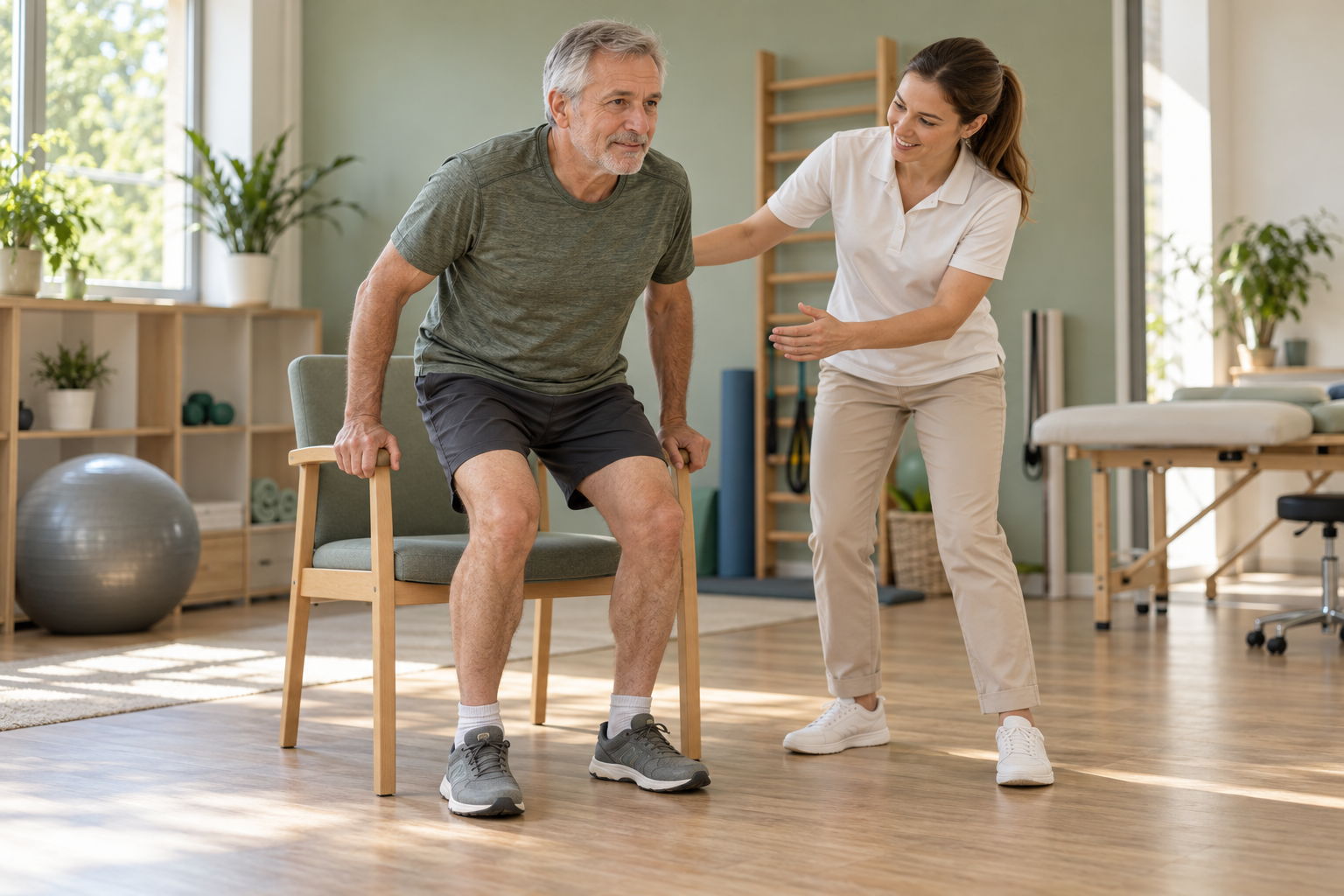
Initially, physiotherapy supports pain and swelling management, wound healing, gradual recovery of mobility, and quadriceps reactivation. Exercises are adapted to the knee's tolerance.
2 – Progression of rehabilitation
The program progresses towards muscle strengthening, balance, support quality, and movement control. It is adjusted according to the individual's mobility, strength, and knee response.
3 – Daily life and work
Walking and climbing stairs are gradually resumed, with technical assistance if needed. Resuming driving depends in particular on mobility, limb control, medication taken, and the ability to brake safely. The return to work varies according to the required movements, postures, and physical exertion.
4 – Sport
The return to sports is gradual and depends on healing, strength, mobility, and the level of functional control. Activities and their intensity are discussed with the medical team before returning to sports that place greater stress on the knee.
The resumption of activities depends on functional recovery and medical validation, not just on the time elapsed.
→ Discover the steps of knee rehabilitation
EXPECTED RESULTS, LIMITATIONS AND RISKS
After the operation, the patient goes to the recovery room where the team monitors his general condition, his pain and the circulation of the operated limb.
The resumption of weight-bearing, exercises and length of hospital stay are adapted to the action performed, the state of health and the initial recovery.
Objectives and expected results
The procedure aims to reduce pain associated with wear and tear in the treated compartment and to improve knee function. By replacing only one area, it preserves the joint surfaces and ligaments, which remain functional. The improvement achieved varies from patient to patient; no specific result can be guaranteed.
Boundaries
A partial knee replacement only addresses the compartment that is being replaced. Pain may persist or recur, and osteoarthritis may progress to other areas of the knee. Recovery also depends on the patient's overall health, any associated injuries, and their participation in rehabilitation.
Risks and complications
As with any surgery, the procedure carries risks, including infection, hematoma, phlebitis, stiffness, persistent pain, or complications related to anesthesia. There is also a risk of malposition, implant wear or loosening, progression of osteoarthritis in another compartment, and, sometimes, the need for further surgery. The team implements appropriate preventative measures and monitoring.
The expected benefit must be weighed against the limitations of a partial replacement and the risks inherent in any surgical intervention.

A CARE APPROACH TAILORED TO EACH PATIENT
Two people with localized wear and tear on the knee do not necessarily experience the same pain and do not always have the same needs.
Dr. Benoît Coulin takes into account age, anatomy, the condition of ligaments and other compartments, the extent of wear and tear, level of activity, profession, treatments already carried out and personal objectives.
The strategy is defined based on these elements: the choice of partial prosthesis, the timing of the procedure, and the recovery program are discussed with each patient. The decision may be reassessed if the surgical findings differ from the preoperative assessment.
«"Only replace what is damaged, when the condition of the knee allows the rest to be preserved."»
Learn more about Dr. Benoît Coulin's background and approach
FREQUENTLY ASKED QUESTIONS
HAVE YOU BEEN OFFERED A PARTIAL PROSTHESIS?
A clinical examination and imaging analysis can determine if the wear is limited to one compartment, compare the options, and choose a strategy tailored to your situation.
