

INTERNAL OR EXTERNAL HIP SHAKE
THE internal or external hip snap, also called trigger hip or coxa saltans, corresponds to the sudden displacement of a tendon or muscle band over a bony protrusion during hip movements.
The clicking sensation may be painless or accompanied by pain, local inflammation, or bursitis. Less commonly, a lesion of the labrum or cartilage may cause a sensation of catching deeper within the joint.
UNDERSTANDING HIP JUMPSUIT
THE INTERNAL LEAP
The internal snapping motion usually occurs at the front of the hip. The iliopsoas muscle tendon can slide over bony prominences located in front of the joint when the hip moves from a flexed to a straight position.
The clicking sound can be felt deep in the groin. It sometimes occurs when getting up from a chair, lifting the leg, climbing stairs, or during certain sporting movements.
THE EXTERNAL STEP
The external snapping hip involves the lateral aspect of the hip. It is often related to displacement of the iliotibial band or the gluteus maximus tendon over the greater trochanter.
The sensation is then more superficial and located on the side of the hip. It may be visible or palpable when the person flexes and then straightens the hip.

RECOGNIZING THE SYMPTOMS
THE internal or external hip snap It can manifest as a clicking sound, a feeling of displacement, or discomfort during certain movements. It may remain painless or become painful when accompanied by tendon inflammation or bursitis.
- Clicking sound at the front of the hip: A snapping sensation felt in the groin may be related to the iliopsoas tendon.
- A clicking sound on the side of the hip: a lateral snapping may correspond to the displacement of the iliotibial band on the greater trochanter.
- Pain during movement: The discomfort may occur when raising the leg, standing up, climbing stairs, or during a sporting activity.
- Sensation of catching or getting stuck: Deep pain in the groin, associated with a catching sensation, requires investigation for possible damage located in the joint.
A persistent painful snap, a significant limitation of mobility, a feeling of locking or pain appearing after an injury should lead to seeking medical advice.
WHY DOES HIP BUMPING APPEAR?
Hip snapping occurs when certain tendons or muscles move over a bony prominence during movement. Several factors can contribute to this phenomenon.
MUSCLE OR TENDON STIFFNESS
A decrease in the flexibility of the iliopsoas muscle, the iliotibial band or the gluteal muscles can alter the gliding of the tendons around the hip.
REPEATED ACTIVITIES
Dancing, running, football, cycling, martial arts and activities involving repeated flexion or rotation of the hip can promote the development of a snapping hip.
OVERLOAD OR TOO FAST RESUMPTION
A significant increase in training, a rapid return to sports, or a change in exercise program can overload the tendons around the hip.
IMBALANCE OF THE PELVIS AND MUSCLES
Weak gluteal muscles, poor pelvic control, or a difference in mobility between the two hips can alter the stresses exerted on the tendons.
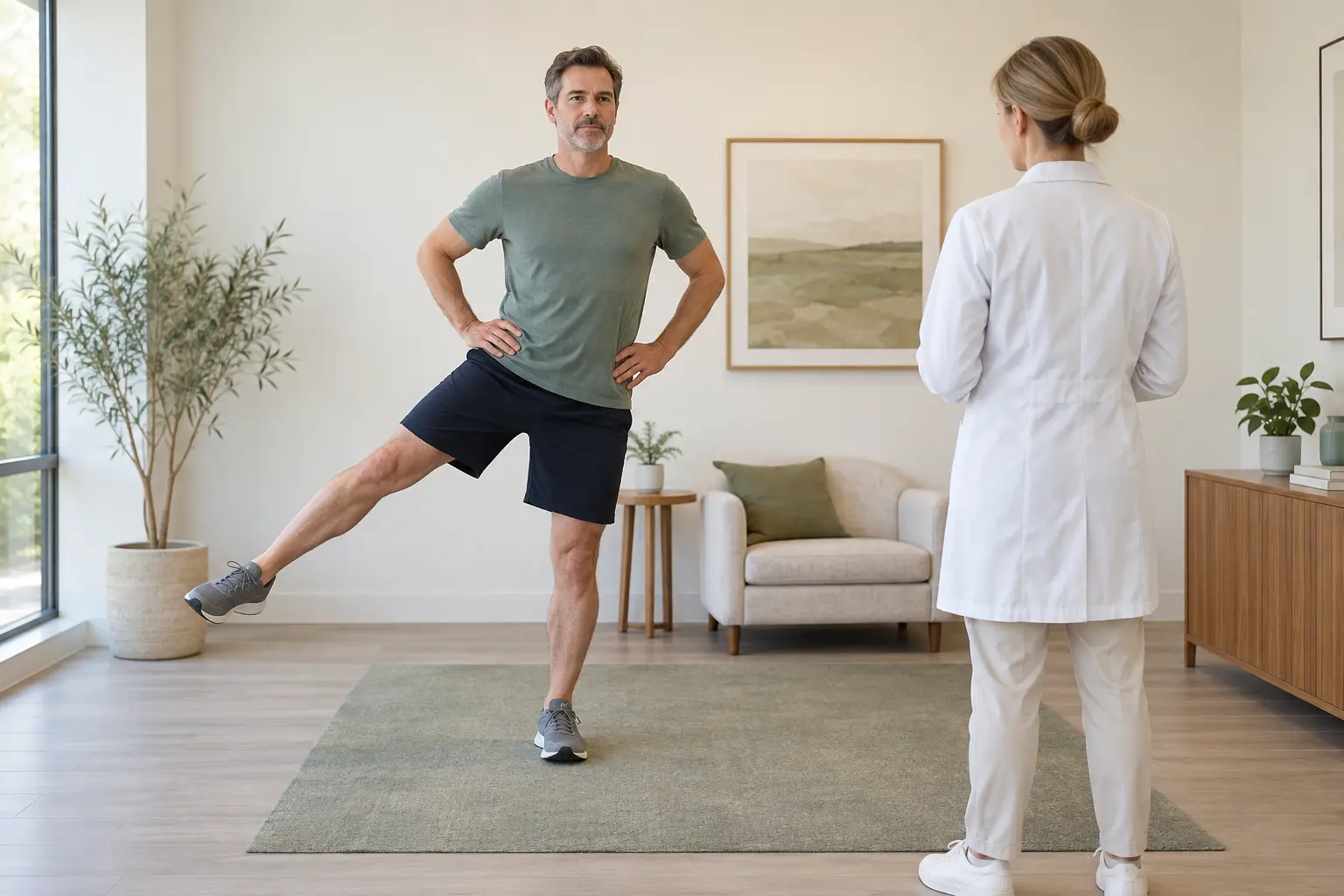
MAKE THE RIGHT DIAGNOSIS
The diagnosis of internal or external hip snap Diagnosis relies primarily on questioning and clinical examination. The doctor seeks to identify the exact location of the clicking sound, the movement that triggers it, and the possible presence of associated pain.
01 – THE CLINICAL EXAMINATION
The doctor observes the gait, hip mobility, and movements that reproduce the snapping sensation. They can sometimes feel the tendon shift under their hand during hip flexion or extension.
02 – THE DIFFERENCE BETWEEN INTERNAL AND EXTERNAL JUMPS
A snapping sensation at the front of the hip suggests an iliopsoas tendon injury. A snapping sensation on the side of the hip may be related to the iliotibial band or the gluteus maximus tendon.
The location of the pain, the depth of the clicking sound, and the triggering movements are important to guide the diagnosis.
03 – IMAGING, SO NECESSARY
An X-ray may be performed to look for a bone abnormality or another cause of pain. Dynamic ultrasound can sometimes directly observe the movement of a tendon during motion.
An MRI may be offered in cases of deep pain, suspected labral injury, cartilage problems, or when symptoms persist despite appropriate treatment.
The clicking sound alone does not allow for a diagnosis: it must be interpreted in relation to the pain, the clinical examination and the movement that triggers it.
RELIEVING HIP SHOCK WITHOUT SURGERY
The management of internal or external hip snap It depends on whether or not there is pain. A painless click generally does not require specific treatment. When the click becomes painful, the goal is to reduce stress and gradually restore smoother movement.
ADAPT THE ACTIVITIES
Movements that trigger pain can be temporarily reduced. It may be necessary to decrease repetitive bending, forced twisting, climbing stairs, or certain sports activities.
The return to activity should be gradual, avoiding intensive repetition of painful movements.
PHYSIOTHERAPY AND MOBILITY
Physiotherapy can help improve hip mobility, reduce muscle tension, and correct certain imbalances.
The program may include gentle mobility exercises, appropriate stretching, and pelvic control work. The exercises should not cause significant pain or increasingly painful jerking.
STRENGTHEN THE HIP MUSCLES
Progressively strengthening the gluteal muscles, core, and hip stabilizer muscles can improve movement control.
The exercises are adapted to the location of the rebound, the muscle strength and the activities of the patient.
TREAT THE ASSOCIATED INFLAMMATION
When an external snapping is accompanied by trochanteric bursitis or when an internal snapping causes painful inflammation, pain relief treatment or targeted injection may sometimes be discussed.
Infiltration is not systematic and should be offered after precisely identifying the structure responsible for the symptoms.
The majority of painful hip snapping can initially be managed through activity adjustments, physiotherapy, and progressive strengthening.

WHEN TO CONSIDER SURGERY?
Surgery is rarely needed for an internal or external snapping of the hip. It can only be discussed when the snapping is painful, disabling, and persistent. despite non-surgical management well conducted.
The decision depends on the patient's age, activities, pain, examinations, and expectations.
PERSISTENT AND DEACTIVATING SYMPTOMS
Intervention may be considered when pain persistently limits walking, sports, or daily activities despite several months of appropriate treatment.
A CONFIRMED ANATOMICAL CAUSE
Before any surgery, it is necessary to confirm the origin of the snapping and to rule out a lesion of the labrum, cartilage, lumbar pathology or other cause of pain.
TARGETED SURGICAL TREATMENT
Depending on the origin of the snapping, an intervention may consist of releasing or lengthening a tendon structure, treating an intra-articular lesion, or correcting a specific mechanical cause.
REHABILITATION AND RESUMPTION OF ACTIVITIES
Recovery depends on the cause of the popping sensation, the presence of inflammation, and the activities performed. It relies on steady progress, avoiding repeated exposure to significant pain.
01 – REDUCE IRRITATING MOVEMENTS
The movements responsible for the painful clicking sound are temporarily limited. The goal is not to completely immobilize the hip, but to reduce excessive stress.
02 – PRESERVE MOBILITY
Hip mobility is maintained through gentle, controlled movements. Ranges of motion that trigger significant pain are avoided initially.
03 – STRENGTHEN THE PELVIS AND GLUTAL MUSCLES
Strengthening begins with simple exercises, then progresses to more functional movements involving the hip, pelvis and trunk.
04 – RESUME WALKING AND DAILY ACTIVITIES
Walking, stairs and usual movements are gradually resumed, monitoring for pain in the hours following the activity.
05 – GET BACK INTO SPORT
Running, jumping, rotating, and changing direction are reintroduced when hip mobility, strength, and control are sufficiently restored.
The return to play depends on the evolution of the pain and the quality of movement, and not on a uniform schedule for everyone.


A CARE APPROACH TAILORED TO EACH PATIENT
A clicking sound in the hip can originate from a tendon, muscle, or joint issue. A consultation will help identify the exact location of the clicking, the movement that triggers it, and the possible presence of pain.
Treatment may combine activity modification, physiotherapy, progressive strengthening and, when necessary, targeted treatment of inflammation.
A painless popping sound usually does not require treatment. However, a painful clicking sound, a deep catching sensation, or limited mobility should be evaluated to determine the underlying cause.
«"Identifying the structure responsible for the rebound helps avoid unnecessary treatments and allows for truly appropriate care."»
FREQUENTLY ASKED QUESTIONS
DO YOU WANT TO BETTER UNDERSTAND YOUR PAIN?
A clinical examination combined with appropriate imaging helps to determine the origin of symptoms and identify the most suitable treatments.
