
INJURY OR TEAR OF THE ACETABULAR LABRUM
THE acetabular labrum, The acetabular rim, also called the acetabular labrum, is a fibrocartilaginous ring located around the acetabulum, the socket in the pelvis that receives the head of the femur. It contributes to hip stability and helps to seal the joint.
A injury or tear of the acetabular labrum It can cause deep pain, often felt in the groin, sometimes accompanied by a clicking or catching sensation. However, an abnormality visible on MRI can also be present without pain: it must be interpreted in conjunction with the symptoms and clinical examination.
UNDERSTANDING THE ACETABULAR LABRUM

RECOGNIZING THE SYMPTOMS
The pain associated with a lesion of the acetabular labrum It is often felt in the groin or deep in the hip. It can appear gradually or after a twisting motion, trauma, or repetitive strain. The symptoms vary from person to person.
- Pain in the groin: sometimes accentuated by deep hip flexion, pivoting, prolonged walking or sitting for long periods.
- Clunking or catching: Some people experience a click, mechanical discomfort, or a feeling of blocking during certain movements.
- Stiffness: The range of motion may seem reduced, especially when rotating the hip or bringing the knee closer to the torso.
- Discomfort during activity: Repetitive movements, changes of direction, or certain sporting gestures can become difficult.
These symptoms are not specific to the labrum; they can also originate from femoroacetabular impingement, cartilage, tendons, or the back. An abnormal image alone does not prove that the labrum is the cause of the pain.
WHY CAN THE LABRUM BE DAMAGED?
A tear can be linked to several factors. It sometimes occurs after trauma or repetitive movements, but it can also be related to the shape of the hip. In some cases, no single cause can be identified.
FEMORACETABULAR BLUNDER
A particular shape of the femur or acetabulum can cause abnormal contact during certain movements. This impingement can irritate the labrum and sometimes the cartilage, especially during flexion and rotation.
REPEATED MOVEMENTS AND PIVOTS
Activities involving deep bending, rotation, or rapid changes of direction can strain the labrum. Repetitive stress can contribute to the development of symptoms.
TRAUMA
A fall, a significant twist, or a shock can cause hip pain and, in some situations, injury to the labrum or other joint structures.
MORPHOLOGY OR OTHER CONDITIONS
Dysplasia or another anatomical abnormality can alter the distribution of stress. Cartilage damage or signs of osteoarthritis may also be present and influence the choice of treatment.
MAKE THE RIGHT DIAGNOSIS
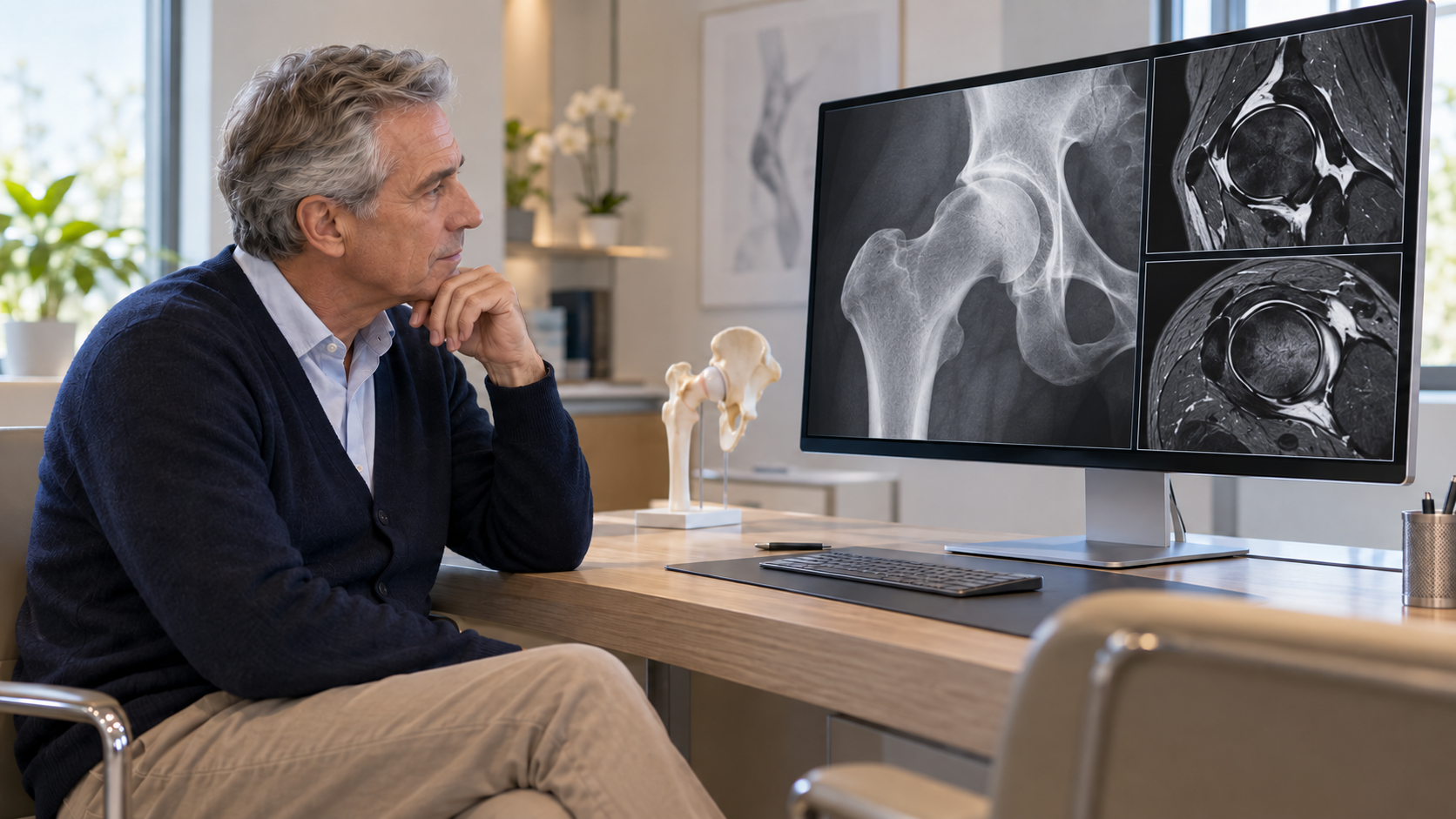
The diagnosis is not based on a single image. It combines the description of symptoms, examination of the hip, and imaging studies chosen according to the situation.
01 – CLINICAL EXAMINATION
The doctor details the circumstances of onset, painful movements, sensations of clicking or locking, and limited activities. Mobility, strength, and other possible causes of pain are also assessed. No single clinical test is sufficient to confirm or rule out a labral tear.
02 – X-RAYS
X-rays of the pelvis and hip allow for the assessment of bone shape, joint alignment, and the possible presence of osteoarthritis. They do not directly show the labrum, but help to identify an associated mechanical cause.
03 – MRI OR ARTHRO-MRI
An MRI can visualize the labrum, cartilage, and tissues around the hip. Depending on the clinical question and image quality, a CT arthrogram or MR arthrogram may be considered. The choice of examination depends on the medical evaluation and its potential contribution to patient management.
The imaging result should always be considered in relation to the symptoms: a lesion may be visible without being the cause of the pain.
Relieve hip pain without surgery
When symptoms are consistent with impingement, conservative management is generally the first approach. This aims to reduce painful movements, maintain function, and gradually improve hip control.
TEMPORARY ADAPTATION OF ACTIVITIES
It can be helpful to temporarily reduce positions that clearly trigger pain, such as repetitive deep bending or certain sports movements. The goal is to maintain a tolerated level of activity, then gradually reintroduce it as the condition improves.
PHYSIOTHERAPY AND MOVEMENT CONTROL
An individualized program can work on mobility, pelvic control, and strengthening of the hip and core muscles. The exercises are tailored to the symptoms and progress according to tolerance.
MEDICATION IF NECESSARY
Pain medication or an anti-inflammatory drug may be considered depending on medical history, contraindications, and the advice of a healthcare professional. The treatment and its duration vary from person to person.
INFILTRATION IN CERTAIN SITUATIONS
An injection may sometimes be considered to help pinpoint the source of the pain or to provide temporary relief, depending on the circumstances. It does not reattach the labrum or correct any existing bone abnormalities.
Treatment is tailored to the symptoms and their cause: the presence of a tear on the MRI does not automatically lead to surgery.

WHEN TO CONSIDER SURGERY?
Arthroscopy may be considered if pain persists and limits activities despite appropriate non-surgical treatment, and if examination and imaging reveal a lesion that could benefit from surgery. The decision also takes into account the cartilage, the shape of the hip, and the individual's goals.
REPAIR THE LABRUM
When the tissue is of sufficient quality and the tear configuration allows, the surgeon can reattach the labrum to the acetabular rim using small anchors. The goal is to preserve as much of the tissue and its function as possible.
REGULARIZING AN INJURED PARTY
If a portion of the labrum is too damaged to be repaired, limited regularization may sometimes be considered. The procedure is decided on a case-by-case basis, with the aim of preserving the labrum as much as possible.
ADDRESS THE RELATED CAUSE
In the presence of femoroacetabular impingement, bone correction can be combined with labral surgery when the indication is confirmed. A different approach may be necessary in cases of dysplasia or advanced joint involvement.
GRADUALLY RESUME ACTIVITIES
Apart from surgery, activities can be maintained or adjusted according to pain levels. A period of reducing movements that trigger symptoms can be followed by a gradual resumption, guided by tolerance and personal goals.
After arthroscopy, recovery depends on the procedure performed: labral repair, regularization, or correction of an associated impingement. Canes and temporary instructions regarding weight-bearing or certain movements may be necessary.
Physiotherapy supports the recovery of hip mobility, strength, and control. The return to running, pivoting, and demanding sports is gradual, following an assessment of progress.
There is no single timeframe for everyone: the return to work is decided based on the action performed, the symptoms and the recovery.


A CARE APPROACH TAILORED TO EACH PATIENT
A labral tear does not always cause symptoms, and hip pain can have several causes. Therefore, management takes into account the discomfort experienced, the clinical examination, imaging, the condition of the cartilage, the morphology of the hip, and the person's activities.
Dr. Benoît Coulin favors a step-by-step approach: identifying the origin of the symptoms, starting with the least invasive and most appropriate measures, and reassessing their effectiveness. If surgery is considered, its purpose and limitations are discussed based on the individual situation.
«"An image of a tear is not enough to explain pain: it must be related to the examination and the movements that are bothering the patient."»
FREQUENTLY ASKED QUESTIONS
DO YOU WANT TO BETTER UNDERSTAND YOUR PAIN?
A clinical evaluation and appropriate examinations will help to identify the source of the pain and discuss treatment options for your hip.
