

RUPTURED PATELLAR TENDON
The patellar tendon connects the kneecap to the tibia and transmits the force from the quadriceps to straighten the knee. When it ruptures, partially or completely, walking and straightening the leg can become difficult.
Management depends on the extent of the tear, the ability to actively straighten the knee, and any associated injuries. A rapid assessment will determine the necessary protection and whether surgical repair should be considered.
UNDERSTANDING PATELLAR TENDON RUPTURE

RECOGNIZING THE SYMPTOMS
After a rupture of the patellar tendon, symptoms often appear suddenly, following exertion or trauma. Their intensity varies depending on whether the rupture is partial or complete.
- Sharp pain in the front of the knee. It occurs at the time of injury and may be accompanied by a tearing sensation.
- Swelling and sometimes a hematoma. The knee can swell rapidly after the injury.
- Difficulty straightening the leg. The person may no longer be able to actively straighten their knee or raise their outstretched leg.
- Walking is difficult or impossible. Pain and loss of strength can make bearing weight and moving around very difficult.
These signs can also be related to a patellar fracture or another injury to the extensor mechanism. A medical evaluation is necessary to confirm the diagnosis. In cases of loss of active extension following trauma, prompt consultation is recommended.
→ Seek prompt medical attention for an acute knee injury
HOW DOES THIS BREAKUP OCCUR?
A rupture of the patellar tendon occurs when the force exerted on the tendon exceeds its resistance capacity. It can occur during a sudden movement or in a tendon that is already weakened.
Sudden contraction of the quadriceps
The tendon can give way during a sudden and powerful contraction, for example to break a fall or to propel oneself forward.
Fall or direct impact
Trauma to the front of the knee can damage the tendon, sometimes with associated bone damage.
Jumps and changes of direction
Certain sporting movements put significant strain on the extensor mechanism, particularly during a landing or a change of direction.
weakened tendon
A pre-existing tendinopathy or certain medical conditions can weaken the tendon and promote its rupture.

MAKE THE RIGHT DIAGNOSIS
The diagnosis is based on the circumstances of the injury, examination of the knee, and, if necessary, imaging studies. Imaging also helps to look for a fracture or other associated injuries.
01 — Ask about the injury
The doctor specifies the movement or trauma that caused the symptoms, their onset, and the difficulties encountered since.
02 — Examine knee extension
The examination assesses swelling, pain, kneecap position, and the ability to actively straighten the knee. A loss of this ability may suggest a significant tear.
03 — Confirm and specify the lesion
An X-ray can be used to look for a fracture or displacement of the kneecap. An ultrasound or MRI may be ordered to determine the extent of the tear and any associated injuries.
Difficulty straightening the knee after an injury requires prompt evaluation.
PROTECT THE KNEE BEFORE DECIDED ON TREATMENT
Non-surgical management may be considered in some partial tears, when active extension remains possible and examination confirms sufficiently preserved function. A complete tear generally requires prompt specialist consultation, as the continuity of the extensor mechanism may be disrupted.
In situations where conservative treatment is appropriate, the goal is to protect the tendon, limit pain, and maintain mobility compatible with healing. The specific guidelines depend on the examination and imaging.
Protect and immobilize
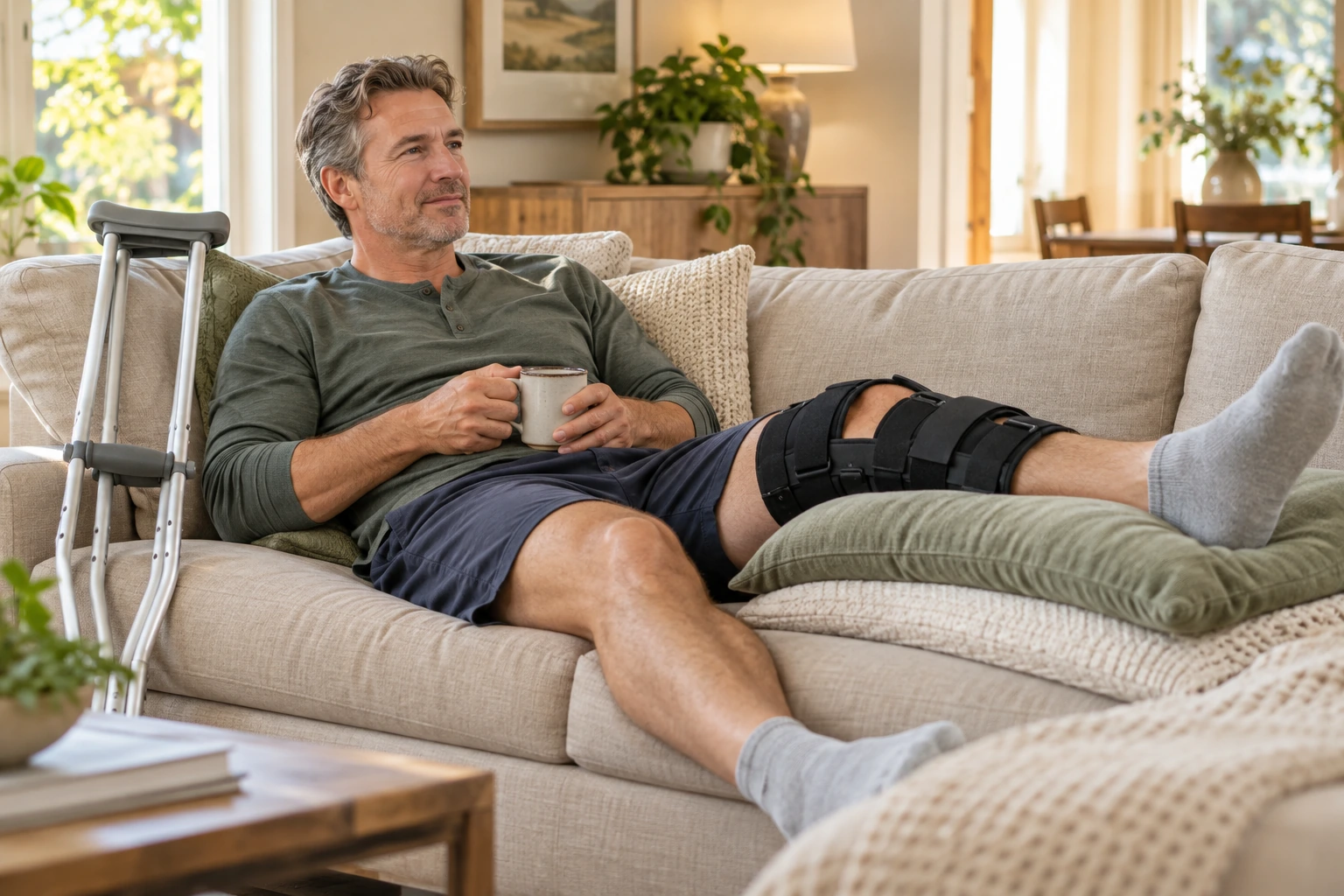
A brace that keeps the knee extended may be prescribed to protect the tendon. Its duration and how it is worn will be determined by the doctor depending on the injury.
Adjust the support
Crutches may be necessary to ensure safe walking and reduce stress on the knee. The permitted level of weight-bearing should follow medical instructions.
Managing pain and swelling
Relative rest, elevating the leg, and applying cold compresses wrapped in a cloth can help with comfort. Medications should be used as directed by a healthcare professional.
Resuming mobility under supervision
Mobilization and physiotherapy begin only according to the specific indications for the injury. Exercises are progressed cautiously to avoid putting too much stress on the tendon prematurely.
Clinical monitoring allows for adjustments to the protection and reassessment of knee function.
WHEN TO CONSIDER SURGERY?
Surgical repair is often discussed when a complete rupture prevents active knee extension. It aims to restore the continuity of the extensor mechanism.
The decision depends in particular on the extent of the rupture, the clinical examination, associated injuries, the patient's general condition, and their goals. The strategy and timeline are determined after specialist evaluation.
Complete rupture with loss of extension
When the tendon is completely ruptured and the patient can no longer actively straighten the knee, surgical repair is usually considered.
Selected partial termination
If part of the tendon remains functional, treatment can sometimes be conservative. The decision depends on the examination and the extent of the tear.
Old or complex lesion
A rupture diagnosed late or associated with other injuries requires a specialist evaluation in order to discuss the most appropriate repair method.
RESUME ACTIVITIES IN STAGES
After a patellar tendon rupture, you should not immediately resume activities that put stress on the knee. The priority is to protect the injury and follow medical instructions.
Walking, knee movements, and strengthening exercises are resumed according to the chosen treatment and observed progress. After surgical repair, the physiotherapy protocol is progressive and adapted to the healing process.
Increasing pain, marked swelling, or a new difficulty straightening the knee should lead to stopping the exercise and seeking medical advice.
The return to daily activities and then to sports is done in stages, taking into account the strength, mobility, and stability of the knee. Changes of direction, jumps, and running require a supervised progression.
The return to work depends on the recovery of function and medical advice.
→ Discover surgery and recovery after a tendon injury


A CARE APPROACH TAILORED TO EACH PATIENT
A ruptured patellar tendon is not treated the same way in all patients. Management takes into account the discomfort, the ability to straighten the knee, and the nature of the injury.
Dr. Benoît Coulin assesses, among other things, the extent of the rupture, its duration, any associated injuries, the patient's general condition, activities, and goals. Clinical examination and relevant imaging studies help to clarify the situation.
Conservative treatment or surgical repair is discussed based on these factors. Knee protection and physiotherapy are then tailored to the patient's progress and functional needs.
«"The goal is to choose a treatment plan tailored to the injury and the situation of each patient."»
FREQUENTLY ASKED QUESTIONS
Have you suddenly lost the ability to straighten your knee?
A clinical examination and, if necessary, appropriate imaging can help determine the origin of the symptoms and allow for personalized management. Rapid evaluation is recommended after an injury accompanied by loss of extension.
