

Fracture of the proximal end (surgical neck) of the humerus
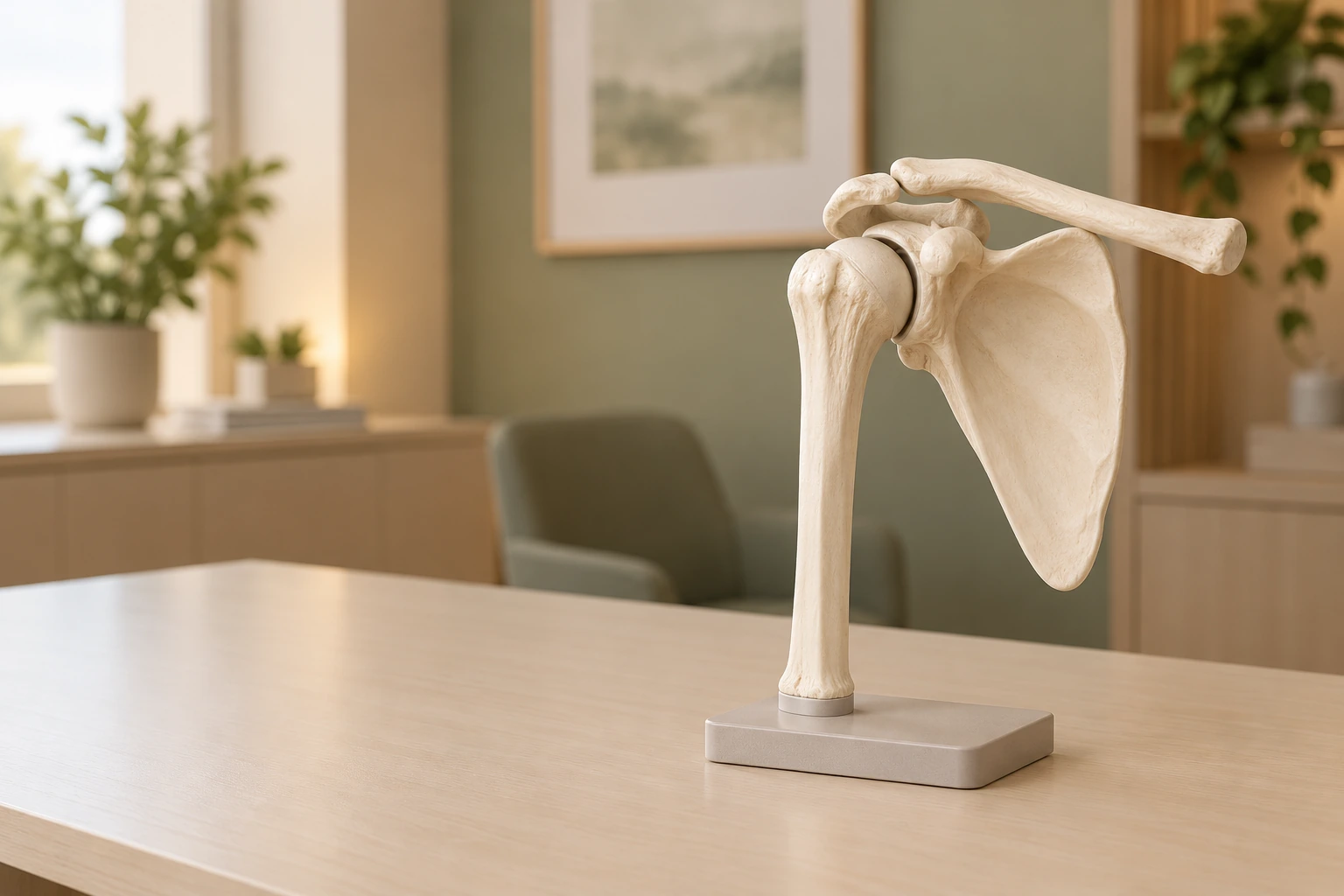
A fracture of the proximal end of the humerus (surgical neck) affects the upper part of the humerus, near the shoulder joint. Depending on its displacement and stability, it can be treated by immobilization and rehabilitation, or may require intervention to reduce and stabilize the fragments.
The decision depends on the clinical examination, X-rays, and sometimes a CT scan, the configuration of the fracture, the person's overall health, and their functional needs. A fracture visible on imaging does not automatically mean that surgery is necessary.
Fracture of the proximal end of the humerus

WHEN TO CONSIDER SURGERY FOR A SURGICAL NECK FRACTURE?
Most proximal fractures of the humerus can be treated without surgery Surgery may be considered when the fragments are sufficiently aligned and the fracture is stable. Surgery may be considered when the configuration risks compromising the healing or function of the shoulder.
- Significant displacement of fragments : alignment may make functional consolidation less likely.
- Unstable or very angled fracture : the fragments risk losing their position during consolidation.
- Associated involvement of the head or tuberosities : neighboring lesions can alter shoulder function and treatment strategy.
- Functional needs and patient context Functional age, bone condition, autonomy, activities and surgical risks are taken into account in the decision.
A minimally displaced fracture generally does not warrant surgery on its own. Even with displacement, the expected benefit of surgery must be weighed against its risks and the potential outcomes of non-surgical treatment. The decision-making criteria remain individualized.
NON-SURGICAL TREATMENT
When the fracture is minimally displaced and stable, it can usually be treated without surgery. Initial management focuses on protecting the shoulder, monitoring healing, and gradually restoring movement.
COMFORT IMMOBILIZATION
A sling supports the arm and helps relieve pain. Its duration depends on the healing of the fracture and medical instructions.
FRACTURE CHECK-UPS
Consultations and imaging examinations help to verify that the fragments remain in the correct position and that the bone is healing.
GRADUAL MOBILIZATION
Hand, wrist, and elbow movements are resumed according to instructions. Shoulder movements begin gradually, at the appropriate time.
PHYSIOTHERAPY
Rehabilitation supports the return of mobility and function of the shoulder, while respecting consolidation and pain.
WHAT TECHNIQUE FOR A SURGICAL NECK FRACTURE?
Surgery is considered when the team believes it can improve the position or stability of the fracture. The strategy takes into account functional age, bone quality, fragment configuration, and the patient's expectations.
Non-surgical treatment remains a common option, particularly for minimally displaced fractures or when surgery would not provide sufficient benefit. The sections below present the main options, without implying that they are all appropriate in every case.
Treatment without surgery
A sling or other comfortable immobilization device protects the arm initially. The duration depends on the pain level and the stability of the fracture. Mobilization of the hand, wrist, and elbow is generally encouraged, while shoulder movements are introduced according to medical instructions and the progress of bone healing.
Mounting with plate and screws
Open reduction and internal fixation with a plate and screws may be used to stabilize certain displaced fragments. The plate is placed on the humerus and fixed with screws adapted to the proximal bone. Bone strength and fracture configuration influence the choice of technique and the possible outcomes.
Intramedullary nail
In some surgical neck fractures, a nail can be inserted into the humeral canal and secured with screws. This option is not suitable for all configurations. The choice depends on the fracture line, its extent, and the stability the surgeon can achieve.
Prosthesis in complex fractures
A shoulder replacement may be considered in certain complex fractures, particularly when the fragments cannot be reliably reconstructed. This option is relevant to a minority of cases and involves specific recovery goals and rehabilitation.
HOW DOES THE PROCEDURE WORK?
The procedure depends on the type of fracture and the technique chosen. The goal, when fixation is indicated, is to reposition the fragments satisfactorily and then stabilize them during healing.
Installation and anesthesia
The procedure is most often performed under general anesthesia, sometimes combined with regional anesthesia to help control pain. The patient is positioned to allow access to the shoulder and for imaging. The skin is disinfected and a sterile surgical drape is applied.
Access to the fractured zone
For plate fixation, the surgeon makes an incision to expose the proximal humerus and protect the surrounding structures. Depending on the case, a less invasive technique or a nail inserted into the bone may be considered. Intraoperative X-rays help visualize the position of the fragments and hardware.
Reduction and fixing
The surgeon repositions the fragments, seeking proper alignment in several planes. The fracture is then stabilized, often using a pre-shaped plate and screws directed into the humeral head. For certain fracture profiles, an intramedullary nail may be recommended. The choice depends in particular on the fracture line, the quality of the bone, and the feasibility of achieving stable fixation. There is no single technique suitable for all fractures.
result check
Intraoperative images allow verification of the alignment, the position of the screws or nail, and the stability of the fixation. The surgeon also checks that the hardware does not penetrate the joint and that the surrounding structures are preserved.
Closure and end of the intervention
After verification, the incision is closed and a dressing is applied. The arm may be placed in a sling for comfort and protection. The patient is then transferred to the recovery room.
The procedure and fixation are chosen according to the fracture and the quality of the bone, with the aim of stabilizing the area while allowing for appropriate rehabilitation.
The duration of the procedure, the type of anesthesia, and the length of hospital stay vary depending on the fracture, the technique used, and the patient's overall health. Hospitalization may be short, but it is not necessarily on an outpatient basis.

Expected results, limitations and risks
The choice of an operation is based on a balance between the expected benefit, the limits of the fix and the risks specific to each situation.
OBJECTIVES AND EXPECTED RESULTS
Treatment aims to promote fracture healing, reduce pain, and restore useful shoulder function. The outcome depends on the fracture, bone quality, associated injuries, and rehabilitation.
BOUNDARIES
Recovery can be lengthy and variable. Stiffness, weakness, or discomfort during certain movements may persist. The fixation alone does not guarantee a complete recovery of mobility.
RISKS AND COMPLICATIONS
Possible complications include infection, hematoma, stiffness, persistent pain, problems with bone healing or fixation, nerve or vascular damage, and the need for further surgery. Individual risk depends on the fracture, the patient's overall health, and the surgical technique used.
REHABILITATION AFTER A SURGICAL NECK FRACTURE
Initially, rehabilitation aims to limit pain and stiffness while protecting bone healing. Arm movements are adapted to the stability of the fracture and the surgeon's instructions.
The progression is gradual: passive or assisted mobility, then active movements and strengthening when the fracture condition allows. The physiotherapist adapts the exercises to the pain level, shoulder control, and the results of medical examinations.
Resuming dressing, driving, work, or household chores depends on arm mobility, pain levels, and the demands of the activity. Lifting heavy loads or straining the arm beyond the limits set by the team should be avoided.
Return to sport is gradual, generally after sufficient consolidation and functional recovery, depending on progress and after medical clearance. Activities with a risk of falls or contact require particular caution.
Shoulder recovery requires a guided progression: protect the bone at the beginning, then regain movement and strength according to progress.


A CARE APPROACH TAILORED TO EACH PATIENT
Two people with a surgical neck fracture that appears similar on an X-ray may have different needs. Displacement, stability, bone condition, associated injuries, and shoulder function prior to the fracture all influence the decision.
The choice of treatment also takes into account the patient's autonomy, daily activities, goals, and the risks associated with surgery. The discussion focuses on the expected benefits, the limitations of non-surgical treatment, and the constraints of surgery.
Dr. Benoît Coulin explains the options after a clinical examination and imaging analysis. A surgical indication cannot be confirmed without an individual evaluation.
FREQUENTLY ASKED QUESTIONS
Do you have a surgical fracture of the humerus neck?
Clinical examination and imaging analysis allow us to assess the displacement and stability of the fracture, and then discuss the treatment best suited to your situation.
