

Fracture of the 5th metatarsal
A fracture of the fifth metatarsal bone affects the outer edge of the foot. Most of these fractures heal without surgery. However, surgery may be considered for some displaced or unstable fractures, some Jones fractures, or when bone healing does not progress as expected. A Jones fracture is located in an area that may heal more slowly.
The decision is based on the examination of the foot, the location and displacement of the fracture, imaging studies, treatments already undertaken, and the person's functional needs.
UNDERSTANDING SURGERY FOR A MEDIAL MALLEOLAR FRACTURE

-
This bony surface is located on the inner side of the knee and receives part of the femur.
-
Located on the outside, it can be touched alone or with the inner tray.
-
Covered with cartilage, it allows movement between the femur and the tibia. A fracture can crack or depress it.
-
The meniscus is located between the femur and the tibia. It can be injured during the same trauma.

WHEN SHOULD SURGERY BE CONSIDERED FOR A FRACTURE OF THE 5TH METATARSAL?
Surgery may be considered when the fracture cannot be maintained in a satisfactory position or when its risk of delayed healing is deemed significant.
- Displaced or unstable fracture — Significant displacement, deformation or instability may lead to discussion of fixation.
- Some Jones fractures Their location can make consolidation more difficult. The level of activity and the characteristics of the fracture are factors in the decision.
- Lack of consolidation — If the fracture remains painful and does not heal sufficiently despite appropriate care, an intervention may be proposed.
- Stress fracture with unfavorable outcome — A persistent or recurrent stress fracture may require specialist evaluation and sometimes stabilization.
A fracture of the fifth metatarsal does not automatically require surgery. Many fractures, including some minimally displaced fractures of the base, can be treated without surgery. The choice depends on the examination and imaging, not on a single image.
PREPARE FOR THE INTERVENTION
The preparation allows confirmation of the type of fracture and planning of an intervention adapted to the bone, the foot and the general state of health.
Preoperative assessment
The team reviews the circumstances of the injury, examines the foot, and reviews the X-rays. A CT scan may be requested if the shape of the fracture needs to be clarified. The anesthesia consultation and pre-operative examinations are scheduled according to the individual case.
Intervention planning
The surgeon chooses the approach and type of fixation based on the location, displacement, and bone quality. The plan can be adjusted during the procedure as needed.
Physical preparation and practice
It can be helpful to plan your return home, anticipate any travel, and familiarize yourself with crutches if they are recommended. The team will explain how to protect your foot after the operation.
Instructions before the operation
Fasting, hygiene, and medication instructions are provided by the medical team. No medication should be stopped or changed without their advice.

HOW DOES THE PROCEDURE WORK?
The procedure depends on the shape of the fracture. Screw fixation may be suitable for some Jones fractures; other configurations may require a plate or other fixation. Intraoperative imaging helps to monitor the position of the fragments and hardware.
Installation and anesthesia
The patient is positioned to allow access to the outer edge of the foot. General or regional anesthesia may be offered depending on the anesthetic assessment. After identity, lateral, and procedural checks, the foot is prepared under sterile conditions.
Access to the treated area
The surgeon makes an incision tailored to the fracture and the planned fixation. The approach is designed to reach the bone while protecting the surrounding tissues and nerve and tendon structures.
Main surgical procedure
If necessary, the fragments are realigned. A screw may be inserted along the axis of the bone to compress and stabilize some Jones fractures. For other fractures, a plate and screws may hold the fragments in place. If the fracture does not heal, the surgeon may need to prepare the healing area; the need for a bone graft depends on the case. Therefore, the type of fixation cannot be determined without precise knowledge of the fracture.
result check
X-rays taken during the procedure allow the surgeon to verify the alignment of the fragments and the position of the hardware. The surgeon also checks the stability of the fixation and ensures that the joints and surrounding tissues are preserved.
Closure and end of the intervention
The incision is closed and then protected with a dressing. A postoperative shoe, boot, or other protective device may be prescribed depending on the fracture and fixation. The patient is then monitored in the recovery room.
The goal is to stabilize the fracture while respecting the anatomy of the foot and the surrounding tissues.
The duration of the procedure, the type of anesthesia, and the return home vary depending on the fracture, the technique used, and the patient's health. Outpatient care may be possible in certain situations.
WHAT TECHNIQUE FOR A FRACTURE OF THE 5TH METATARSAL?
The location and displacement of the fracture guide the choice of fixation. The techniques are not interchangeable: an intramedullary screw may be suitable for some fractures, while a plate may be preferable for others.
The decision also takes into account bone quality, the patient's activity level, and the existence of a recent fracture, fatigue, or failure to heal.
Intramedullary screw
A screw is inserted into the bone canal, usually along the axis of the fifth metatarsal. This option is often discussed for certain Jones fractures. It requires a precise choice of length and diameter and is not suitable for all fracture morphologies.
Plate and screws
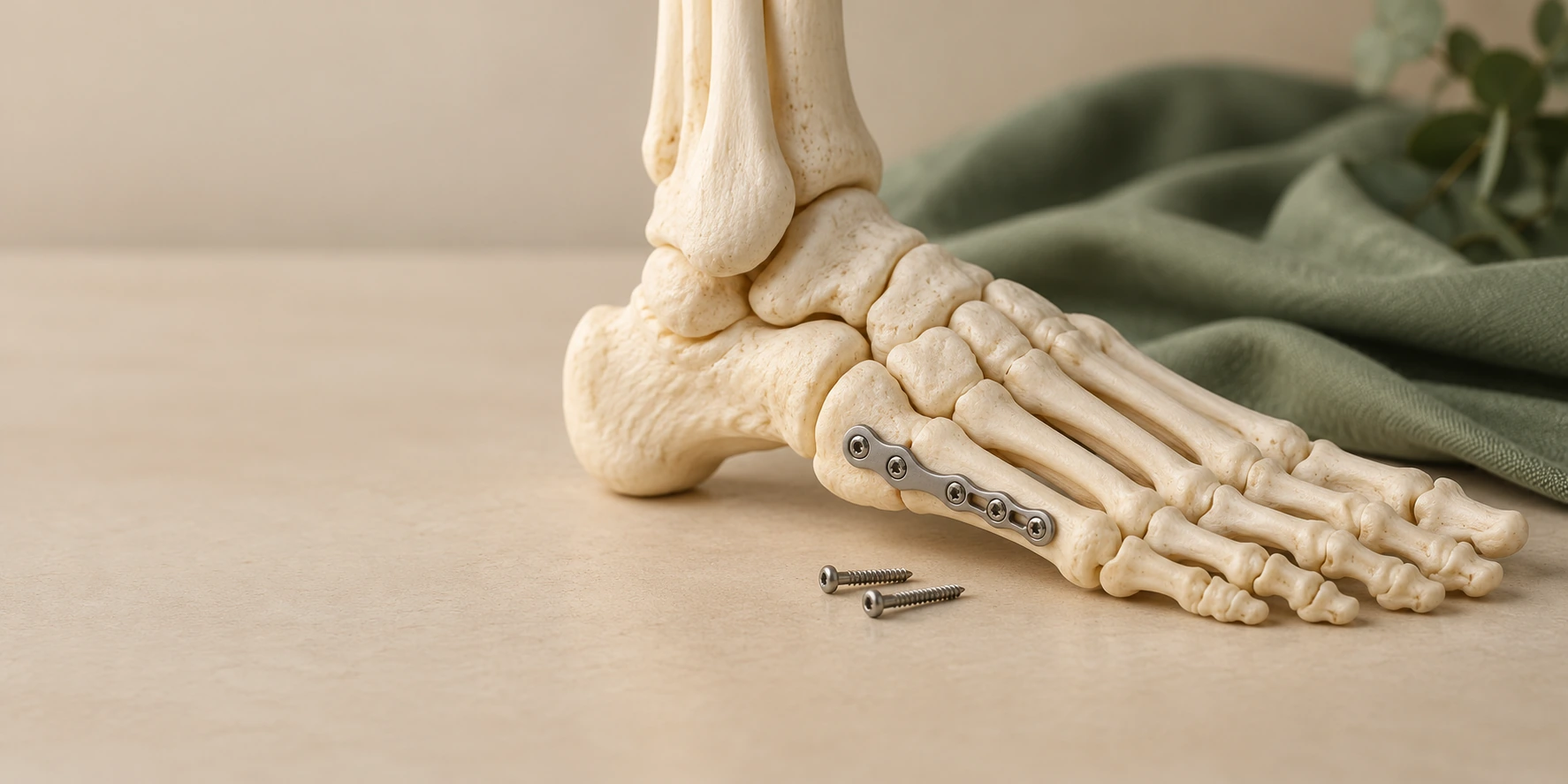
A plate secured with several screws can stabilize certain displaced fractures or fractures with a configuration less suited to intramedullary screw placement. Positioning must take into account the superficial tissues of the lateral border of the foot.
Fracture reduction
When the fragments are displaced, the surgeon can reposition them before fixation. The importance of this step depends on the alignment, stability, and shape of the fracture.
Delayed consolidation or absence of consolidation
For certain fractures that remain painful and do not heal, preparation of the fracture site and, in some cases, a bone graft may be considered. The choice depends on the assessment and findings during surgery.
The fixation method is chosen to suit the actual configuration of the fracture, and not according to a single technique for all.
AFTER THE PROCEDURE: THE FIRST STEPS
After the operation, the team monitors pain, the dressing, and circulation in the foot. Initial instructions for weight-bearing and protection are given before the patient returns to the ward or home.
The duration of monitoring depends on the anesthesia, the procedure, and the patient's overall condition. Returning home the same day may be possible in some cases.
Recovery room and pain
Pain is assessed and managed according to medical instructions. The team checks the dressing and monitors sensation and circulation in the foot.
Support, walking and immobilization
Weight-bearing may be permitted, limited, or temporarily prohibited depending on the fracture and fixation. Crutches and a postoperative shoe or boot may be necessary. Follow the instructions given for movement and mobilization.
Delayed consolidation or absence of consolidation
The dressing care and follow-up date will be specified by the team. Contact a professional promptly if the pain or swelling worsens significantly, if the foot becomes cold, pale or numb, or if there is fever or drainage from the wound.
RECOVERING AFTER 5TH METATARSAL SURGERY
Initially, the goals are to protect the fixation, monitor healing, and limit pain and swelling. Foot positioning and rest periods are prescribed by the team.
Resumption of movement and rehabilitation progress according to the healing of the fracture. Exercises can then work on ankle and toe mobility, strength, balance, and gait quality, while respecting weight-bearing guidelines.
Walking, climbing stairs, driving, and work depend on the operated side, pain levels, the ability to move safely, and job requirements. A return to sedentary work may differ from returning to a job involving walking or lifting.
Sport is resumed in stages after assessment of bone healing and sufficient recovery of strength, mobility, and balance. The timeframe varies depending on the fracture and the activity; a return to sport must await medical clearance.
Progress is based on the consolidation and function of the foot, without seeking to accelerate the stages.

EXPECTED RESULTS, LIMITATIONS AND RISKS
Objectives and expected results
Fixation aims to maintain the fragments in a favorable position and allow for healing. It also seeks to reduce the risk of displacement or persistent symptoms when the fracture requires surgery.
Boundaries
Healing and functional recovery take time and vary depending on the location of the fracture, bone quality, adherence to instructions, and the patient's overall health. Discomfort, local tenderness, or stiffness may persist during recovery. Surgery does not guarantee immediate healing or a return to previous activity levels.
Risks and complications
Like any surgical procedure, fixation carries risks of infection, hematoma, wound healing problems, or phlebitis. Irritation from the hardware, persistent pain, delayed or absent bone healing may also occur. A second procedure is sometimes necessary.
The expected benefit of the operation is weighed against its limitations and risks for each patient.

A CARE APPROACH TAILORED TO EACH PATIENT
Two people with a fracture of the 5th metatarsal do not necessarily require the same treatment. Some fractures heal with protection and weight-bearing adjustments, while others may require fixation.
Dr. Benoît Coulin takes into account the location and displacement of the fracture, the quality of the tissues and bone, functional age, activity level, occupation, associated injuries, and treatments already undertaken. The patient's expectations and daily constraints are also part of the discussion.
The technique, the timing of the intervention and the recovery program are defined based on these elements and reassessed according to clinical and radiological progress.
«"Treatment must address the observed fracture and the individual's functional needs."»
FREQUENTLY ASKED QUESTIONS
Does a fracture of the 5th metatarsal require surgery?
A clinical examination and imaging analysis allow us to assess the location and stability of the fracture, and then discuss the treatment best suited to your situation.
