

Patella fracture
The kneecap is a small bone located at the front of the knee. A fall or impact can fracture it, causing pain, swelling, and difficulty moving the leg.
Treatment depends on the position of the fragments and the function of the mechanism that allows the knee to straighten. Depending on the fracture, treatment may involve protection and monitoring, or may require surgery.
UNDERSTANDING A PATELLAR FRACTURE

-
A small bone located in front of the knee, it protects the joint and participates in leg extension.
-
It connects the thigh muscles to the upper edge of the kneecap.
-
It connects the lower edge of the patella to the tibia and transmits the extension force.
-
It covers the back of the kneecap and facilitates its gliding against the femur.

RECOGNIZING THE SYMPTOMS
After a fall or impact, the pain is often located at the front of the knee. Swelling can appear quickly and make movement difficult.
- Pain in the front of the knee
It can be intense after the injury. It sometimes worsens when the knee moves or when the leg bears weight. - Swelling and bruising
The knee may swell and show bruising around the kneecap. - Difficulty walking
Bearing weight may be painful, or even impossible, depending on the fracture. - Difficulty straightening the leg
Some fractures disrupt the extension mechanism and prevent active straightening of the knee.
These signs can also be related to other knee injuries. A medical examination and X-rays will confirm the diagnosis. In case of significant trauma, inability to bear weight or straighten the leg, consult the information on [the relevant resources] as soon as possible. knee fractures and their management.
HOW DOES A PATELLAR FRACTURE OCCUR?
The kneecap can fracture when a direct impact or strong traction from the thigh muscles exceeds the bone's strength. The mechanism and displacement of the fragments influence treatment.
Direct fall onto the knee
A fall onto a hard surface is a common mechanism. The force of the impact can cause a simple or fragmented fracture.
Impact to the front of the knee
An impact during an accident or against an object can directly damage the kneecap and the tissues around the joint.
Sudden contraction of the thigh
A very strong contraction of the quadriceps can exert significant traction on the kneecap and cause a fracture, sometimes without direct impact.
Stable or displaced fracture
The fragments may remain close together or move apart. The articular surface and the extension mechanism may also be affected.

MAKE THE RIGHT DIAGNOSIS
The diagnosis is not based solely on imaging. The doctor considers the circumstances of the injury, the examination of the knee, and the results of any necessary tests.
01 — INTERVIEW AND CLINICAL EXAMINATION
The doctor will explain the mechanism of the fall, the pain, and any difficulties encountered. He will examine the swelling, the painful areas, and, if possible, the ability to actively straighten the knee.
02 — X-RAYS
X-rays usually confirm the fracture and allow for assessment of the position of the fragments. Several views can be taken to better observe the patella.
03 — ADDITIONAL EXAMINATION IF NECESSARY
A CT scan can clarify a complex fracture or damage to the joint surface when this information helps in choosing the treatment. An MRI is not always necessary.
The position of the fragments and the extension function guide the choice of treatment.
TREATING THE FRACTURE WITHOUT SURGERY
A stable fracture, with little or no displacement, can sometimes be treated without surgery if the extension mechanism remains functional. The decision is based on clinical examination and imaging.
The goal is to protect the fracture during its healing process while gradually preserving knee mobility and strength. Guidelines vary depending on the specific fracture.
Protect the knee
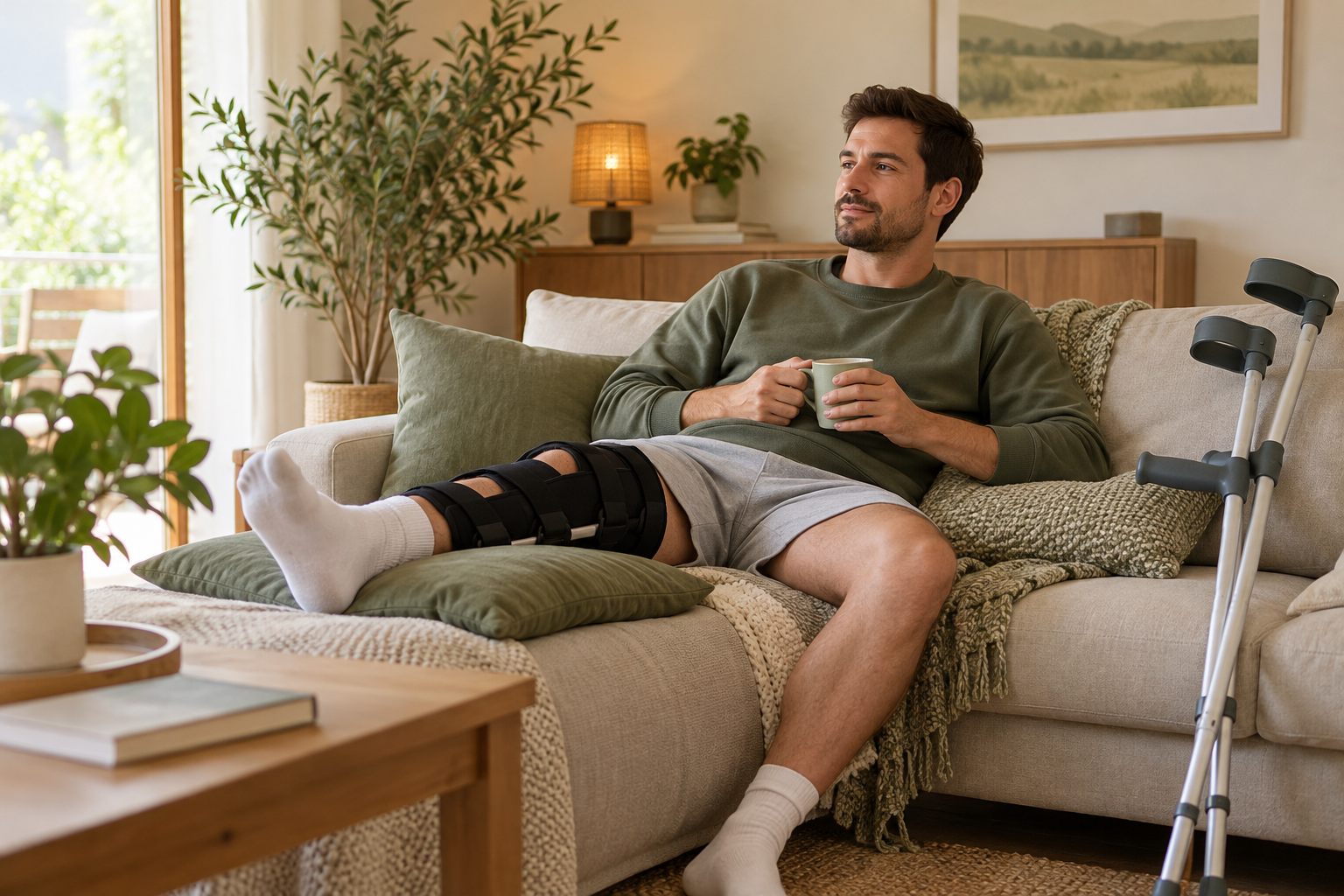
A brace or orthosis may be prescribed to maintain the knee in the recommended position. The duration of use depends on the stability of the fracture and medical check-ups.
ADAPT SUPPORT AND MOVEMENT
The healthcare team will provide specific instructions regarding weight-bearing. Crutches may be temporarily useful to facilitate movement or reduce stress on the knee.
RELIEVE PAIN AND SWELLING
Relative rest, leg elevation, and the careful application of cold can contribute to comfort. Pain medications should be chosen based on medical history and any contraindications.
FOLLOW THE CONSOLIDATION
Follow-up appointments, and sometimes X-rays, verify that the fragments remain in the correct position. Physiotherapy is introduced according to the healing process and the permitted range of motion.
Protection and monitoring allow for a gradual adaptation of the resumption of movements.
WHEN DOES INTERVENTION BECOME NECESSARY?
Surgery may be considered when the fragments are displaced, the joint surface is misaligned, or the fracture prevents the knee from being straightened. An open fracture requires urgent evaluation.
The decision takes into account the type of fracture, the condition of the tissues, extension function, and the patient's overall health. Not all patellar fractures require surgery.
Fragments displaced
When the fragments have separated or the articular surface is misaligned, fixation may be discussed to restore patellar alignment.
→ Understanding fracture surgery
Compromised knee extension
If the fracture interrupts the mechanism that allows the leg to straighten, a specialist evaluation helps determine if surgical repair is necessary.
→ Discover the management of knee and fractures
Open or complex fracture
A wound adjacent to the fracture or a complex configuration requires rapid assessment. Treatment is determined based on the extent of bone damage and that of surrounding tissues.
Surgery is reserved for fractures whose stability or function cannot be sufficiently preserved without intervention. To understand the main principles, consult Fracture surgery: indications and management.

GRADUALLY RESUME ACTIVITIES
Rehabilitation begins according to the type of treatment and the degree of consolidation. Exercises and restrictions are adjusted by the healthcare team; the timeframe varies depending on the fracture and the clinical progress.
01 — Protect the fracture
Initially, the instructions focus on protecting the kneecap and any fixation. Wearing the brace, weight-bearing, and permitted movements follow the recommendations received.
02 — Gradually regain mobility
When permitted, flexion and extension exercises are gradually resumed. The goal is to limit stiffness without putting excessive stress on the fracture.
03 — Restore strength
Physiotherapy helps to reactivate and then strengthen the thigh muscles and to gradually regain control of extension. The load and exercises are adapted to the pain level and the healing process.
04 — Resume daily activities
Walking, transfers, stairs and professional activities resume in stages, depending on mobility, strength, balance and the ability to move safely.
05 — Consider resuming sports
Sports activities can be resumed when consolidation and functional capacity allow. Strength, knee control, absence of significant swelling, and tolerance of sporting movements are assessed before a more demanding return to activity.
Progression should follow the consolidation and function of the knee, and not an identical schedule for everyone. To learn more, consult the guidelines for knee rehabilitation after a fracture.
A strategy tailored to each patient
Two fractures of the patella are not necessarily treated in the same way. Dr. Benoît Coulin takes into account the displacement of the fragments, the condition of the articular surface, the ability to straighten the knee, associated injuries, the patient's age, general health, and activities.
When the fracture is stable and the extension mechanism is functioning, non-surgical management can avoid surgery and its associated hardware. However, this requires appropriate protection and follow-up to verify the position of the fragments. If the fracture is displaced or compromises extension, fixation may be considered to restore alignment and function. This involves surgery and progressive rehabilitation.
The choice of treatment is based on clinical examination and imaging, and is then reassessed according to the consolidation and recovery. The goal is to offer the treatment that corresponds to the fracture and the patient's needs.
«"For a fractured patella, treatment is determined based on its alignment and the function of the knee."»

FREQUENTLY ASKED QUESTIONS
Have you suffered a fall or impact and are you having difficulty straightening your knee?
A clinical examination combined with X-rays confirms the fracture, assesses the displacement of the fragments, and determines whether the extension mechanism is intact. Treatment is then tailored to the characteristics of the fracture and your individual situation.
