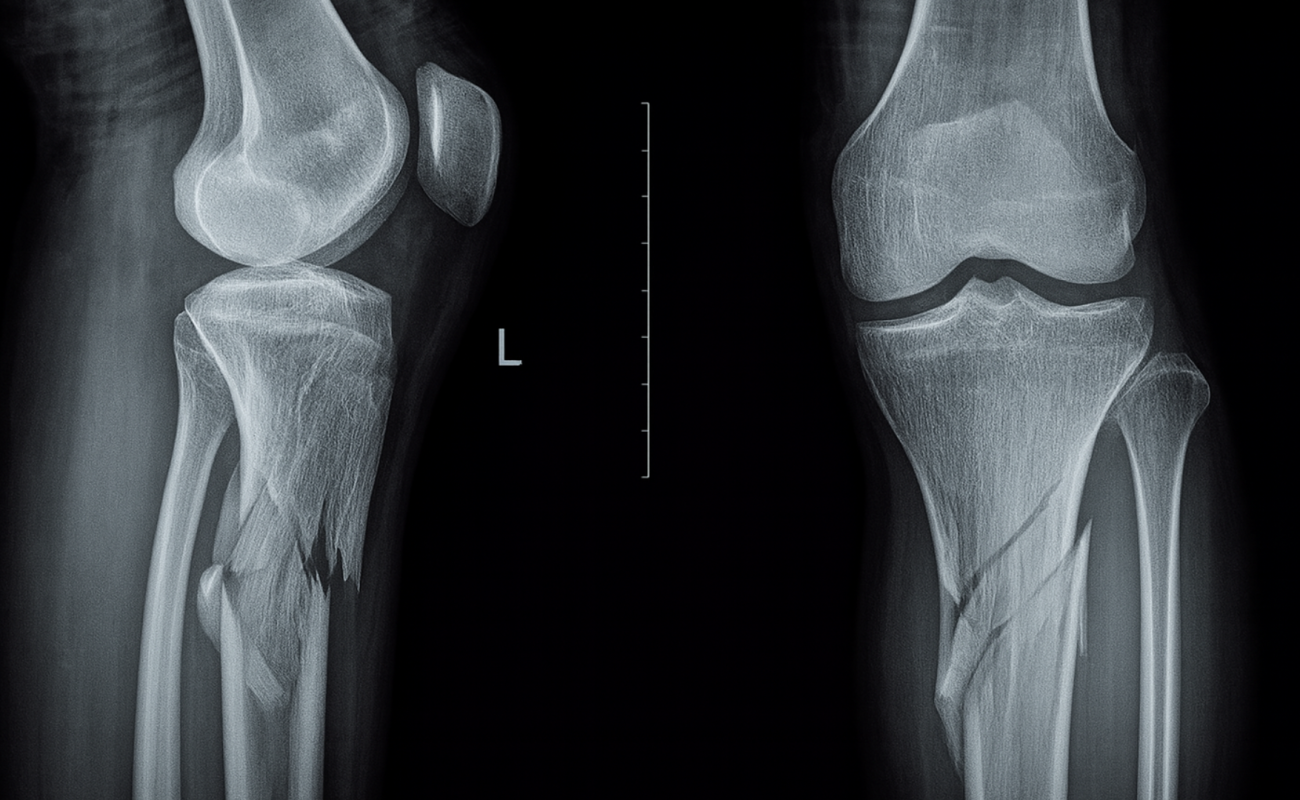

A common injury in active patients
Not all fractures require surgery. In many cases, standard orthopedic treatment (immobilization, splint, cast) allows for natural healing. However, when a bone is displaced, unstable, or affects a joint, fracture surgery often becomes necessary to restore alignment, stabilize the bone, and allow for optimal recovery.
Dr. Coulin analyzes each situation individually, based on the clinical examination, imaging (x-rays, scanner) and the patient's functional objectives.
What is fracture surgery?
Fracture surgery involves realigning and stabilizing a broken bone when it cannot heal properly through immobilization alone. The procedure allows for the repositioning of bone fragments, ensuring their stability with implants (screws, plates, nails, pins), and promoting rapid and functional healing.
Beyond bone repair, surgery also aims to limit long-term complications: chronic pain, loss of mobility, secondary osteoarthritis. It is an integral part of orthopedic traumatology and concerns both:
- young and athletic patients, who need to regain a high level of function,
- than elderly patients, for whom rapid recovery of autonomy is essential.
At what point is fracture surgery considered?
The decision to opt for a fracture surgery is based on several specific criteria. It is indicated when the fracture presents:
- Significant displacement of bone fragments.
- Joint damage, threatening long-term mobility.
- A failure of conservative treatment (plaster cast or splint).
- A need for a rapid return to autonomy, particularly among active or elderly patients.
Some fractures require surgical treatment more often:
- The femoral neck, the operation of which prevents a permanent loss of mobility.
- The wrist (distal radius), in order to prevent deformities and residual pain.
- The ankle, which must be perfectly stable to avoid secondary osteoarthritis.
- The clavicle, when the displacement is too pronounced.
- There kneecap, if the fracture prevents extension of the knee.
Open, multiple, unstable fractures or fractures associated with nerve or ligament damage are also frequent indications for fracture surgery.
How does the procedure with Dr. Coulin take place ?
The goal of fracture surgery is to realign the bone fragments, then to stabilize them permanently to allow the bone to heal under good conditions.
The procedure is performed under general or local anesthesia, depending on the location and profile of the patient.
Techniques used include:
- The installation of screws, plates, nails or pins to fix the bone.
- Temporary external fixation, in complex or polytrauma cases.
- Associated procedures, such as tendon repair or nerve release, if necessary.
Dr. Coulin favors approaches minimally invasive whenever possible, in order to limit surgical trauma, reduce post-operative pain and speed recovery.
What are the post-operative consequences ?
The consequences depend on the location of the fracture and the type of fixation. However, some principles are common:
- Early mobilization as soon as possible, in order to avoid complications related to immobility (muscle loss, stiffness, phlebitis).
- Targeted rehabilitation, essential to restore mobility, muscle strength and proprioception.
- Regular radiological monitoring allows for the control of bone consolidation.
In some cases, the implants remain in place permanently. In others, they can be removed after consolidation, depending on age, activity level, and any discomfort experienced.
What results can you expect ?
Fracture surgery allows, in the majority of cases, for solid healing and satisfactory functional recovery. Thanks to modern techniques and personalized care, the results are very encouraging:
- Rapid return to walking or independence.
- Significant pain relief.
- Reduction in the risk of joint damage (stiffness, osteoarthritis).
- Return to sport or professional activity within a suitable timeframe.
The quality of the result depends on the surgical technique, the rigor of the rehabilitation and the patient's involvement in their follow-up.
Have you suffered a recent fracture or fall?
A fracture or a recent fall A medical evaluation is required to confirm the diagnosis, assess the severity of the injury, and rule out any associated ligament, meniscus, or cartilage damage. Through a thorough clinical examination and analysis of your imaging studies, Dr. Coulin will develop a personalized treatment plan, whether conservative or surgical. Early intervention promotes optimal healing, minimizes complications, and allows you to regain your mobility in the best possible conditions.